As the train started to slowly crawl out of the dimly lit station, I caught glimpses of pages fluttering restlessly from an old, forgotten book lying abandoned on the ground and flickers of light were suddenly blurred and distant. We soon raced past the opposite train on the other platform which had become a blur of unknown faces and memories. Wind thudded past my ear and my hands clamped readily the velour armrests. The train continued to accelerate and soon it glided out of the station leaving behind us the curving glint of the train tracks. As the last glimmer of light receded into the inky sky, I turned my eyes and attention to the train and my new travel companions. I had reserved in the Kupeny class ;I recognized the four bunks, the small wooden fold-out tables the little desk lamps,the carpeted floor and walls and most of all the large, frosty windows and curtains. I stowed my rucksack in the luggage space above the door extending out over the corridor of the carriage and kept my shoulder bag with my laptop and regained my upper bunk. All of the travelers in the cabin were speaking Russian enthusiastically to one another; after exchanging a few friendly words in my poor Russian, and seeing that I was very keen on speaking as much Russian as possible they affably asked me a few friendly question of what my name was, what was my nationality and how brave I was to endure alone such a journey! They were very impressed and content that I had come all the way to discover their native country and soon merged into excited chatter about recent experiences and adventures and the journey ahead awaiting us. Whenever I stumbled on a Russian word everyone eagerly tried to guess and exchange words both in English and Russian, collapsing in laughter as nobody could understand each other any more!
The lady who had chosen the upper bunk across from me, called Larissa was a Russian history and geography teacher in a school in Yekaterinburg who had come not only to visit her brother in Irkutsk but also to experience the famous journey across Russia. Among the other travelers were a brother and sister and another voyager from who was from France who was also partly Russian. I asked her a few questions of her country such as it's different climates throughout the country.
I took some notes:

- Russia has continental climate due to it's size and compact disposition. Russia's mountain ranges,mostly towards the south and east, prevent moderating temperatures from the Indian and Pacific oceans.
- Extensive regions experience six months of snow cover over subsoil that is permanently frozen to depths as far as several hundred meters. The average yearly temperature of nearly all of European Russia is below freezing, and the average for most of Siberia is freezing or below. Most of Russia has only two seasons, summer and winter, with very short intervals between them.
- The long, cold winter has a profound impact on almost every aspect of life in Russia. It affects where and how long people live and work, what kinds of crops are grown, and where they are grown (no part of the country has a year-round growing season).In regions of permafrost, buildings must be constructed on building piles, machinery must be made of specially tempered steel, and transportation systems must be engineered to work reliably in extremely low and extremely high temperatures. During extended periods of darkness and cold, there are increased demands for energy, health care, and cloths.
As we slowly pulled into the Krasnoyarsk station, I asked whether Larissa would be stopping or continuing the voyage, and said that she would regret to have to continue the voyage. Since we would not be traveling together anymore we exchanged our addresses and email addresses and I was quite disappointed though I had to push away my sadness and concentrate on the voyage ahead. And maybe we would even see each other again on the Trans-Siberian in another story, memory, blog.
I made a quick list of Things to see and do in Krasnoyarsk:
-Museums : visit Regional Museum, Surikov's arts gallery museum
-city tours
-monuments, famous landmarks
-restaurants:
City Tour:
I took a short city and museum tour that extended through from the Intercession Cathedral to the Regional Museum and Surikov's art gallery museum.
Here are some quick photo shots I rapidly took of the landmarks we walked past:
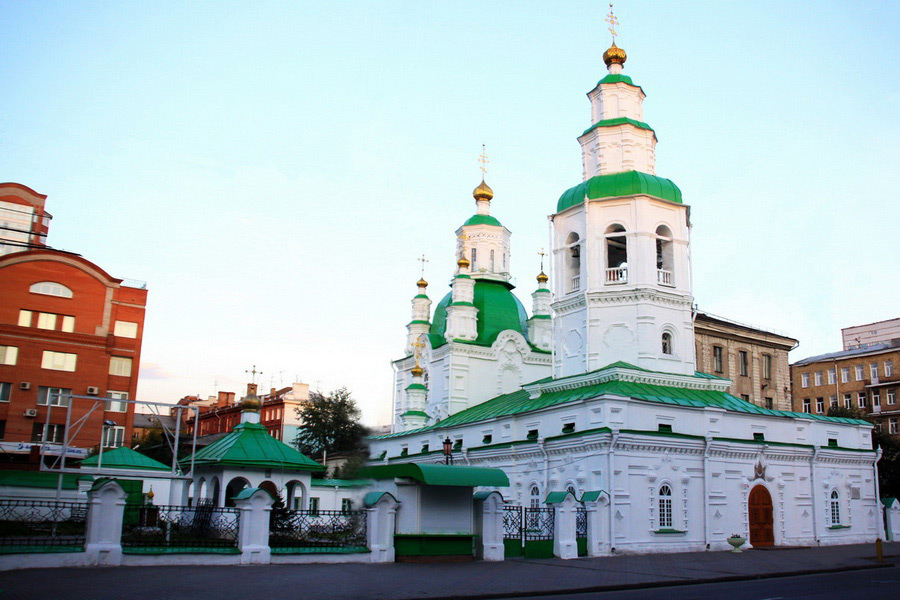
The Intercession Cathedral is a very beautiful and intricately decorated cathedral, dating to be the oldest of the buildings in Krasnoyarsk, and established in 1785. The silhouette of the tier five domes are crowned with golden octagonal onion cupolas with figured crosses. The architecture of the cathedral is of Siberian Baroque style.

The Regional Museum of Krasnoyarsk is one of the oldest museums in Siberia; It was opened in 1889. The Museum is built in a very unique style of architecture although it is said that incorporates the features of the modern style combined with the elements of ancient Egyptian architecture. The exposition of the museum begins with the history of ancient tribes, which inhabited the Yenisei region.
There was a ethnographic collection, labelled ‘Peoples of Siberia’ which presented national clothing, tools and cult-objects of the Nenets, the Evenki, The Iganasans, the Kets, the Dolgans and a number of other peoples inhabiting the territory of Krasnoyarsk region. There is also a unique paleontological collection in the Krasnoyarsk Museum; the fragments of skeletons of rare animals; such as cave lion, primitive aurochs, large-horned deer. The largest representatives of the glacial fauna are placed in the center of the exposition .
In the halls devoted to the history of the Yenisei province a broad panorama of Russian development of Siberia is presented, where is exhibited great geographical discoveries made by Russian pathfinders. 
The Surikov Art Museum is the only large art museum in Krasnoyarsk, and was opened in 1958. The exposition of the museum represents the ancient Russian art (icons, graphics, sculpture, decorative arts), Russian avant-garde, the art of the XX century, Western European art of the XVII – early XIX century., folk art. Russian art of the XVIII-XIX centuries; represented by the works of I. Kramskoy, I. Aivazovsky, I. Shishkin, V. Tropinin, I. Repin, A. Makovsky and A. Benoit. One of the prides of the museum is a collection of paintings by B. Surikov (including 78 works), exhibited in a separate room in the museum.
I really enjoyed the city tour and the different museums we visited, particularly the Surikov Art Museum for it's large selection of Russian artifacts.
After the tour, it was about 6:00 and I decided to have an early dinner out in a restaurant in Krasnoyarsk. Dinner began with elegant chopped boiled potatoes salad and cabbage soup called Sshchi, serving for the first course; I chose for a delicious main course of fish and vegetables with a side dish of potatoes.


You pay such attention to the details which make the salt of life. What was that abandoned book doing there, with its pages fluttering in the wind?
ReplyDeleteYour writing is absolutely fabulous!
An impressive account of the departure. You have also accurately captured the intense emotional contact that can be created between people who travel together, especially the pain of separation.
ReplyDelete